real biathlon
    • Athletes
    • Teams
    • Races
    • Seasons
    • Scores
    • Records
    • Blog(current)
    • More
      Patreon Content Videos Explanations Shortcuts
      Error Report
      Privacy Policy About
    •     
  • Forum
  • Patreon
  • X
  • YouTube
    Instagram
    Facebook

Recent Articles

  • Biathlon World Cup podiums (1958 – 2025)
  • Junior + U23 Development Index – Men
  • Junior + U23 Development Index – Women
  • The Path to GOAT Status
  • Most improved athletes this winter

Categories

  • Biathlon Media
  • Biathlon News
  • Long-term trends
  • Statistical analysis
  • Website updates

Archives

  • 2025
    • November
  • 2024
    • March
  • 2023
    • March
  • 2022
    • December
    • June
    • May
    • March
    • February
    • January
  • 2021
    • December
    • November
    • September
    • July
    • June
    • May
    • April
    • March
    • February
    • January
  • 2020
    • December
    • November
    • August
    • June
    • March
  • 2015
    • December
  • 2013
    • August
    • July
  • 2012
    • July

Search Articles

Recent Tweets

Tweets by realbiathlon

Category: Statistical analysis

Predicting the World Championships in Pokljuka

Posted on 2021-02-06 | by biathlonanalytics | Leave a Comment on Predicting the World Championships in Pokljuka

One of the reasons I really love biathlon is that it is unpredictable. Yes, there are favourites who win more regularly than others, but there are always a large number of athletes who can take the win. Yet my next Tableau Dashboard is called Pokljuka Predictions. Well, I ran out of space to add “well, not really”. But to make predictions to the best of one’s ability, having all the right information in front of you is the best option you have. And that is what this dashboard is supposed to do: provide useful information that allows making the best possible prediction.

The dashboard works per Race Category (gender) and Race Discpline. After selecting these two parameters we can have a look at the charts but first, let’s look at some info on the events.

They are held in Slovenia, at the Pokljuka Biathlon Stadium

The program is a busy one for the athletes, but this report excludes the relays.

After setting the filters, three of the four “columns” show data, where the central column at the bottom shows data when an athlete is selected.

The scatterplot shows the athletes related to their last race in Pokljuka in this Discipline and their current standing in the World Cup for this discipline. X’s mean that the athlete either did not participate in the most recent Pokljuka event, or is not in the current season Discipline Standings. It gives an idea of what athletes are good this season and did well in the last race in Pokljuka for this discipline. They will show up in the top right.

The following two charts show similar data from above but individually: the race results for this discipline in previous seasons (when available), and the current World Cup standings for this discipline with points and ranking in brackets.

When selecting an athlete in any of these charts, we can see the current season results in the selected discipline for the selected athlete, compared to their career (since the 16-17 season) average (dark blue dashed line) and the current season’s average (light blue dotted line).

This is followed by the athlete’s current form based on consistency;it shows the absolute change in rankings per season, so the higher the value (lower on the chart), the larger the inconsistency. And the steepness of the decline shows the athlete’s form. Steep points to a big change in results, where a almost flat decline indicates that recent results were similar. It does not indicate however if these results were high or low in the ranking. If an athletes was 45th, 43rd and 44th the line will be almost flat indicating strong consistency. this will gie you an idea of likelyhood that it will change soon, or if this athlete’s performance is pretty reliable.

Last thing to mention is that when you hover your mouse over a name of an athlete, it highlights that athlete in other charts.

So all in all not a true predictor, but a tool providing information to make a better-informed prediction quicker.

UPDATE – Predictions after all, and some updates to the dashboard

So, based on the information on the dashboard I really felt I should make some predictions after all. Although I will not commit to pointing who will get what place, I will highlight the top favourites for every race, based on the dashboard.

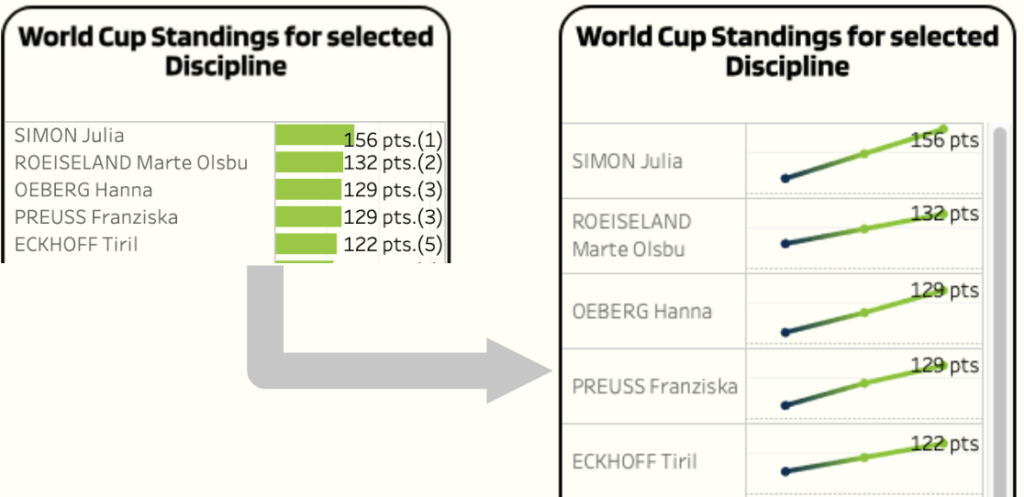
I also changed one chart on the dashboard replacing the one that showed the current standing to the cumulative points this season to give a better idea of when the points were scored; recently or early in the season:
Men’s Sprint – It’s hard not to bet on JTB here; He won in Pokljuka in the 18-19 season, he won the last two sprints, has a lowest ranking of 4th this season and leads the Spring Standings. His brother Tarjei, was 4th two seasons ago, had a win and second place this season but a lowest ranking of 15th, so definitely more inconsistent. He’s 4th in the current standings. Outside favourites are Lukas Hofer, recently in good shape and improving, and despite his miserable rankings this season so far I would not write off Loginov: he was 3rd in 18-19 at this venue, and won last year’s World Championships in Antholz, showing he knows how to peak for a major championship. Dale and Laegreid are 2nd and 3rd in the current season standings but with only one and zero respectively World Championships and Pokljuka races under their belt (with a 23rd place for Dale in Antholz) I can’t see them ending up with a gold medal.

Women’s Sprint – Eckhoff won the last three Sprints of this season, but did not participate in the most recent Sprint in Pokljuka. She also leads the standings this season. Wierer was 2nd in 18-19 in Pokljuka, and is 10th in the current standings. She has been inconsistent this season but her last race was a 2nd place. I would consider Preuss an outsider, being 9th in Pokljuka in 18-19 and a current 4th spot in the standings. Braisaz-Bouchet is another outsider to keep an eye on, being 3rd in 18-19 and scoring a 14th, 9th and 4th position in the last three races. Hauser was 50th in 18-19, but was 3rd in the last two races this season, and has since won a 1st place so she is in very good shape.

The Men’s Pursuit is harder to predict with the obvious dependency on the Sprint results. Laegreid, JTB, and Dale lead the standings, and JTB also won in 18-19 in Pokljuka. Tarjei Boe has been improving since the start of this season (12-7-7-3) and was 6th in 18-19. QFM was 2nd in 18-19, has won a race this season, but has been very inconsistent. Loginov is an outsider again, 3rd in 18-19 but the highest position of 17th this season, as is Hofer with an 8th position in 18-19 and a 5th spot in the last race.

Women’s Pursuit – Wierer and Roeiseland, 6th and 2nd in the current standings and 2nd and 5th in 18-19 have a good chance for a top 5, but based on the current season results Eckhoff again has the best cards, especially if she does well in the Sprint. Hauser and Preuss are strong outsiders again with solid scores in 18-19 and decent results this season.

Women’s Individual – Dzhima, 2nd in the standings and winning in Pokljuka in 18-19 and a 14th in 19-20 and a 2nd spot in the last race this season has the best cards for this race. Hanna Oeberg has a strong history in Pokljuka (8th in 18-19, 2nd in 19-20) but this season has not been great for her. Hauser was 9th and 7th in Pokljuka and won the most recent race this season for her first World Cup win. Herrmann and Vitozzi are strong outsiders with solid results in 19-20 (1st and 4th) and Vitozzi in 18-19 as well (6th). Vitozzi’s season has had a tough current season with a highest position of 13th, and Herrmand aslo had a rough season so far.

Men’s Individual – Since JTB won last year in Pokljuka and a 7th spot in the year prior and 4th spot on the standings, it’s hard not see him as a favourite again. Fillon Maillet was 7th last year and has a 4th and 3rd this season so he’s a contender for sure. Loginov won the most recent race but with a 16th and 29th rank in the last two races in Pokljuka, he’s an outsider. Hofer and Laegreid are outsiders as well with a 1st and 2nd for Laegreid this season, and a 4th in the most recent race for Hofer, plus a 13th position last year.

Women’s Mass Start – Simon is hard to ignore for a favourite, winning the last two races this season and being 11th in last year’s race in Pokljuka. However, Hanna Oeberg won there last year and was 3rd and 2nd this season, so I would consider her to be the favorite, even over Simon. Outsider Roeiseland won the other Mass Start this season, and had two 7th places, as well as a 6th last year. Hauser was 3rd in the last race this season and 7th last year in Pokljuka so she is a strong outsider too.

Men’s Mass Start – This will be a tight one, and both Boe brothers and Fillon Maillet all being strong contenders, with Tarjei leading the standings and being 9th last year, JT winning the most recent race, being 2nd in the standings as well as last year, and QFM winning last year, 2nd in the most recent race and 4th in the standings. Eder is a strong outsider (8th last year and most recently, and 5th in the standings), as are Doll (2nd last year, a 4th and 7th this year), Peiffer (13th last year, a 1st, 11th and 5th this season) and Hofer (10th last year, and a 4th this season).

That’s it, those are the big players in these championships, but since we’re talking biatlon here, the chances of being wrong with predictions are pretty high.

Posted in Long-term trends, Statistical analysis | Tagged Pokljuka, World Championships

A Sturla Holm Lægreid special

Posted on 2021-02-04 | by biathlonanalytics | Leave a Comment on A Sturla Holm Lægreid special

Sturla Holm Lægreid has had an amazing season so far. This visual shows all his results in IBU Cup and World Cup races, tracked by the IBU.

First, we look at the ranks and bibs he has achieved, followed by Z-Scores for Skiing, Shooting and Range Time. Then we dial in on the shooting, looking at every shot he fired, and lastly at the moving averages of his Prone, Standing and Total Shooting Percentages.

SHLspecial (PDF) Download
SHLspecial (JPG)Download
Posted in Statistical analysis | Tagged Athlete special, Sturla Holm Lægreid

IBU -vs- WorldCup Performance, part I

Posted on 2021-02-01 | by biathlonanalytics | Leave a Comment on IBU -vs- WorldCup Performance, part I

Now that the Realbiathlon website has some IBU data as well (available to Patreon supporters), I wanted to do a comparison of metrics for athletes that competed at both levels for a minimum of five races (leaving 437 observations). Although there are different race disciplines for the two levels, in this first look I included all disciplines and combined the categories (genders). I looked at all athletes that competed in the current or last season at the IBU level, and at the World Cup level since the 16-17 season (661 athletes).

These charts are nothing fancy, just comparing athlete’s average metrics for the two levels and drawing a trend line to see what relationship exists between the results for the following metrics:

  • Total Shooting Percentage
  • Prone Shooting Percentage
  • Stand Shooting Percentage
  • Course Time
  • Shooting Time
  • Range Time

As the P-value for all charts is smaller than 0.0001 we can say all relationships are statistically significant, or, that there is a relationship between the results at the two different levels. But how strong is the relationship?

  • R2 = 0.929
  • P < 0.0001

For the Total Shooting percentage the relationship is very strong: if a shooter has a certain percentage at the IBU level, almost 93% of the time the shooter is has a similar percentage at the World Cup level.

Prone and Stand don’t differ much, with Prone having a 0.907 R2, and Stand a 0.916 R2.

Since Course time, Shooting time and Range time are not expressed in percentages but in Z-values, which looks at how how much the times differ from the average (negative is faster, positive is slower), we see different patterns. But the relationships are still very strong:

  • R2 = 0.851
  • P < 0.0001
  • R2 = 0.902
  • P < 0.0001
  • R2 = 0.899
  • P < 0.0001

In general, we can say that metrics from IBU level races translate very well to World Cup level races, but since the level of competition at the World Cup level would likely be higher than on the IBU level, the results for the athletes could, and likely will be very different. To make this more clear, here are the averages for the used shooting metrics at the two levels for all 661 athletes (rather than the subset of 437 athletes that have a minimum of five races at both levels):

  • Shooting Percentage: 80.1% (WC) versus 77.5% (IBU)
  • Prone 82.8% (WC) versus 80% (IBU)
  • Stand 77.34% (WC) versus 75% (IBU)

Note: Course Time, Shooting Time and Range Time are all Z-scores so on average they are the average (0).

From the shooting averages, we can conclude that the average shooting is better at the World Cup level than at the IBU level, which is what you would expect. So an athlete who had the same score on both levels can be above average at the IBU level and below the average at the World Cup level.

I hope to do further research on the IBU data once more seasons become available in the summer. To be continued.

Posted in Long-term trends, Statistical analysis | Tagged IBU, World Cup

The Consistency of Consistency tool

Posted on 2021-01-28 | by biathlonanalytics | Leave a Comment on The Consistency of Consistency tool

In biathlon, consistency is something most athletes are looking for, ideally from one season to the next, assuming the performance in a certain metric is at the level they are happy with. I built a dashboard in Tableau Public that looks at the career and seasonal form, averages and variance, and at consistency for the following metrics:

  • Prone Shooting
  • Standing Shooting
  • Total (combined) Shooting
  • Ski speed (in Km/H)
  • Ski Score (Z)
  • Rank
  • Shooting Time Score (Z)
  • Range Time Score (Z)

From the RealBiatlon.com website: Z-score (Standard score) Number of standard deviations by which metrics are above or below the mean (based on back from median data)

The data used goes back to the 2016-2017 season, so when I refer to career averages the data will not include any data from before the 2016-17 season. To highlight this I have used an asterisk whenever using career. Please note that when using different metrics like this, the meaning of above zero and below zero is not always positive or negative. I.e. Z scores for skiing are better when negative (meaning below average) but for shooting percentage the higher number the better.

As examples often are a good way of explaining visualizations I am going to start with Lisa Hauser, and her Ski Score (Z).

Chart 1: Averages

This simply shows Lisa’s average for Ski Score (Z) and the sharp drop for the current season clearly stands out, meaning she went from a just below average skier to a faster than average skier. Also, we can see she has been much faster than her career* average, indicating she must have really focussed on her skiing the last preparation. Has that affected her shooting? Let’s see by changing the metric to Total (combined) Shooting and look at…

Chart 2: Actual Results

This tells us that her current season’s average and her career* average are almost identical, so no change here. We can also see that as the season progresses she is seeing better results (for shooting percentage, higher is better).

Now can we get more out of this? The following shows the difference between actual results and the career* average and shows it cumulatively, based on the assumption the multiple bad results in a row, even with a good result between a number of bad ones, has a bad impact on form.

Chart 3: Cumulative difference for career*

Due to her less than ideal first number of races (with regards to total shooting) and a lesser performance in the last race of the previous season, the chart shows a lower than desired profile, that however sings upward towards the current status of the current season.

One could argue however, that the seasons are separate entities, and the end of last season would not impact the form of an athlete at the start of the current season.

Chart 4: Cumulative difference for season

The same applies in this case for the current season, showing the bad start and the incline due to better results in the second trimester, but the previous season now has no impact at all. A better example of showing a differnece between career* and season is the follwing for Shooting Time Score (Z):

If we want to see more about consistency, the metrics are used in absolute form. It doesn’t matter if a result is good or bad, as long as it differs from the previous results it introduces inconsistency. So the next chart shows the absolute values of the differences between actual race resultes and season averages.

Chart 5: Cumulative absolute difference for season

Now the hight (or depth) of the chart shows the size of inconsistency, where the direction and steepness show how much the race result impacted the consistency.

Lastly to satisfy the more statical inclined readers below are the Variance charts, showing the spread of results and the average Variance per season (still Lias Hauser’s Shooting time score (Z)).

Chart 6: Variance

This dashboard is not coming to a specific conclusion, but rather a tool to further research an athletes’ performances, form, and consistency, intended to be used interactively by you! So go have a look and have fun with it.

Posted in Long-term trends, Statistical analysis | Tagged Tableau, Tool

Ski speed – First vs. second trimester

Posted on 2021-01-28 | by real biathlon | Leave a Comment on Ski speed – First vs. second trimester

The season is already more than halfway over. Who managed to improve their ski form during the winter? In this post, I looked at changes in ski speed for World Cup trimester 1 compared to World Cup trimester 2 (November/December 2020 vs. January 2021). For patrons, I recently updated the comparisons bonus section – there you can compare all shooting and skiing stats on your own, not only season-to-season, but also by trimester now.


Note: Only athletes with at least 5 non-team races in trimester 1 and trimester 2 of the current season are included in the tables. “Back from Top30 median” is the percentage back from each race’s top 30 median Course Time (arithmetic mean per trimester).


Men

Surprise podium finisher Felix Leitner managed to improve his ski speed by roughly 1.3% compared to pre-Christmas races. Lukas Hofer improved by virtually the same amount, although he did so on a much higher level (he was the fourth-fastest skier overall for trimester 2). A lot has been made about Johannes Thingnes Bø not dominating as he did in previous seasons, however, his ski speed certainly isn’t to blame; he set the top course time in 5 out of 6 races in January!

Jakov Fak had a great start to his season (four top 10s in a row), but his ski speed is now trending in the wrong direction before the upcoming world championships in Pokljuka. Sebastian Samuelsson‘s speed has declined 1.4% post-Christmas, his average ski rank is 10.9 positions lower. Fabien Claude isn’t doing much better, he also has a ski rank now roughly ten places lower compared to World Cup trimester 1.

Changes in Ski Speed World Cup Trimester 1 vs. World Cup Trimester 2 | 2020–21 season

NoFamily NameGiven NameNationRacesSki Rank
(avg)
Changeback from
Top30 median
(in %)
Change
NoFamily NameGiven NameNationRacesSki Rank
(avg)
Changeback from
Top30 median
(in %)
Change
1LeitnerFelixAUT
619.8-16.6+0.71-1.29
2HoferLukasITA
66.2-7.2-1.51-1.26
3GuigonnatAntoninFRA
620.0-11.0+0.44-1.16
4EliseevMatveyRUS
518.8-17.0+1.07-1.07
5DollBenediktGER
612.5-3.5-0.92-0.92
6FinelloJeremySUI
518.4-9.2+0.26-0.90
7PeifferArndGER
611.5-6.5-0.73-0.90
8BoeJohannes ThingnesNOR
61.3-1.1-3.36-0.70
9DesthieuxSimonFRA
614.7-4.9-0.15-0.60
10EderSimonAUT
634.0-5.2+2.04-0.54
11Fillon MailletQuentinFRA
58.6-2.4-1.11-0.47
12LaegreidSturla HolmNOR
69.7-3.9-0.95-0.41
13KomatzDavidAUT
640.8-5.6+3.18-0.37
14LatypovEduardRUS
616.2-2.7+0.18-0.23
15DaleJohannesNOR
63.0-3.1-1.99-0.02
16JacquelinEmilienFRA
610.5+0.3-0.71+0.10
17BoeTarjeiNOR
66.0+1.4-1.55+0.23
18FakJakovSLO
623.2+3.2+0.71+0.25
19PonsiluomaMartinSWE
67.8+2.2-1.40+0.27
20RastorgujevsAndrejsLAT
522.8+2.2+0.82+0.32
21LesserErikGER
621.5+2.8+0.70+0.34
22WegerBenjaminSUI
624.8+4.6+0.98+0.39
23FemlingPeppeSWE
542.2-9.7+4.06+0.41
24BionazDidierITA
544.6+0.2+3.65+0.45
25ChristiansenVetle SjaastadNOR
518.2+4.9+0.11+0.74
26LoginovAlexanderRUS
521.2+7.5+0.52+0.77
27BocharnikovSergeyBLR
532.6+5.1+1.98+0.92
28ClaudeFabienFRA
619.8+9.6+0.39+1.07
29SamuelssonSebastianSWE
619.2+10.9+0.26+1.39


Women

Elena Kruchinkina, who set the fastest course time in the first Oberhof sprint (before that she never had a top 3 course time), is the most improved skier among regular female starters: 2.4% faster compared to December and her average ski rank is now 16.5 positions lower. Yuliia Dzhima and Svetlana Mironova come second and third, skiing 2.0% and 1.6% faster respectively. Two-time winner Julia Simon improved almost as much percentage-wise, but more importantly, she was the fourth-fastest skier in January.

Monika Hojnisz-Staręga is missing here, because she only appeared in three races in January, however, she would have topped the ranking, 3.4% faster than in trimester 1. Dorothea Wierer‘s skiing has improved slightly, but her average ski rank in January (16.8) is still way behind her average from last season (10.0). Elvira Öberg and Mona Brorsson have been struggling in recent races, both roughly 3% slower in January.

Changes in Ski Speed World Cup Trimester 1 vs. World Cup Trimester 2 | 2020–21 season

NoFamily NameGiven NameNationRacesSki Rank
(avg)
Changeback from
Top30 median
(in %)
Change
NoFamily NameGiven NameNationRacesSki Rank
(avg)
Changeback from
Top30 median
(in %)
Change
1KruchinkinaElenaBLR
510.2-16.5-0.84-2.39
2DzhimaYuliiaUKR
523.0-18.6+0.81-1.96
3MironovaSvetlanaRUS
612.2-13.3-0.57-1.59
4SimonJuliaFRA
66.5-12.8-1.57-1.42
5HettichJaninaGER
627.5-15.3+1.62-1.32
6HinzVanessaGER
530.8-14.2+1.88-1.15
7KaishevaUlianaRUS
625.8-13.3+1.55-1.02
8VittozziLisaITA
521.2-10.2+0.95-0.88
9HerrmannDeniseGER
64.2-4.2-1.90-0.65
10ZdoucDunjaAUT
636.2-15.4+3.16-0.55
11WiererDorotheaITA
616.8-4.3+0.11-0.49
12EckhoffTirilNOR
62.3-3.2-2.38-0.44
13HauserLisa TheresaAUT
610.5-2.2-0.76-0.39
14PavlovaEvgeniyaRUS
524.4-5.1+1.09-0.35
15RoeiselandMarte OlsbuNOR
62.8-1.7-2.24-0.28
16DavidovaMarketaCZE
66.5-0.4-1.29+0.14
17PreussFranziskaGER
612.7+0.6-0.39+0.17
18LunderEmmaCAN
535.8-1.3+2.59+0.18
19BescondAnaisFRA
619.0+3.0+0.34+0.18
20PerssonLinnSWE
623.3+4.0+0.68+0.35
21AlimbekavaDzinaraBLR
615.7+1.4+0.12+0.46
22Braisaz-BouchetJustineFRA
67.8+2.1-1.03+0.59
23OebergHannaSWE
616.7+4.7-0.09+0.62
24Chevalier-BouchetAnaisFRA
613.2+5.7+0.08+1.23
25TandrevoldIngrid LandmarkNOR
520.0+12.9+0.58+1.86
26EganClareUSA
634.7+6.6+3.12+1.88
27KnottenKaroline OffigstadNOR
647.3+14.4+4.56+2.67
28OebergElviraSWE
624.5+17.8+1.25+2.89
29BrorssonMonaSWE
546.6+17.7+4.72+3.17

Overall, the Swedes arguably stand out the most, doing particularly poorly after Christmas – all of their regular starters declined in the new year (often by a lot). Alternatively, you could look at it the other way around: they simply outperformed, especially in Kontiolahti, and now regressed to a more normal level.

Posted in Statistical analysis | Tagged ski speed

Posts navigation

Older posts
Newer posts

Recent Articles

  • Biathlon World Cup podiums (1958 – 2025)
  • Junior + U23 Development Index – Men
  • Junior + U23 Development Index – Women
  • The Path to GOAT Status
  • Most improved athletes this winter

Categories

  • Biathlon Media
  • Biathlon News
  • Long-term trends
  • Statistical analysis
  • Website updates

Archives by Month

  • 2025: J F M A M J J A S O N D
  • 2024: J F M A M J J A S O N D
  • 2023: J F M A M J J A S O N D
  • 2022: J F M A M J J A S O N D
  • 2021: J F M A M J J A S O N D
  • 2020: J F M A M J J A S O N D
  • 2015: J F M A M J J A S O N D
  • 2013: J F M A M J J A S O N D
  • 2012: J F M A M J J A S O N D

Search Articles