real biathlon
    • Athletes
    • Teams
    • Races
    • Seasons
    • Scores
    • Records
    • Blog(current)
    • More
      Patreon Content Videos Explanations Shortcuts
      Error Report
      Privacy Policy About
    •     
  • Forum
  • Patreon
  • X
  • YouTube
    Instagram
    Facebook

Recent Articles

  • Biathlon World Cup podiums (1958 – 2025)
  • Junior + U23 Development Index – Men
  • Junior + U23 Development Index – Women
  • The Path to GOAT Status
  • Most improved athletes this winter

Categories

  • Biathlon Media
  • Biathlon News
  • Long-term trends
  • Statistical analysis
  • Website updates

Archives

  • 2025
    • November
  • 2024
    • March
  • 2023
    • March
  • 2022
    • December
    • June
    • May
    • March
    • February
    • January
  • 2021
    • December
    • November
    • September
    • July
    • June
    • May
    • April
    • March
    • February
    • January
  • 2020
    • December
    • November
    • August
    • June
    • March
  • 2015
    • December
  • 2013
    • August
    • July
  • 2012
    • July

Search Articles

Recent Tweets

Tweets by realbiathlon

Category: Statistical analysis

Canadian performances in Biathlon since 2000

Posted on 2020-06-24 | by biathlonanalytics | Leave a Comment on Canadian performances in Biathlon since 2000

By Najtrebor

This article mainly uses data from Senior-level, non-team IBU Biathlon events since 2000, unless indicated otherwise. The data come from the IBU (www.biathlonresults.com) starting with the 2000-2001 season, and going up to (and including) the 2019-2020 season). It combines all race results with Event, Race and Athlete data, although the Athlete data is limited to Senior and IBU Cup level. Unfortunately, the detailed race-data with ski- and shooting times per loop, is only available through PDF-files that so far provide a too-big-a-hurdle to conquer! (Clearly, I wrote this article before this amazing website was re-instated!) But what the current data set provides is ranks, final times and general shooting results.

Participation – all levels and events

While the average number of all participants in IBU events has been very steady in the last 20 years, Canada’s participation has slowly increased, as shown in Figure 1. Although the growth appears to be levelling out in recent years at all three levels, over the 20 year period there is a slow incline, specifically for Junior and Senior events.
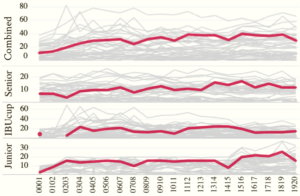
Note that the 2019-2020 season was not fully completed due to COVID19, likely leading to lower overall participation numbers.

World Cup Points

The total number of World Cup Points per nation is dependent on the number of participants and how race results are linked to points. But at this level of (semi-)professional sports, to evaluate a nation’s success, the points are usually all that matters. Since the total number of points is more relevant when compared to other nations, the chart below shows national points per season at the Senior level for non-team events, for all nations, with Canada highlighted in red.
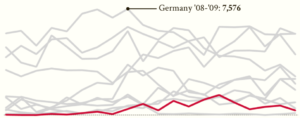
Unfortunately, it appears Canada has been in decline in the last couple of seasons.
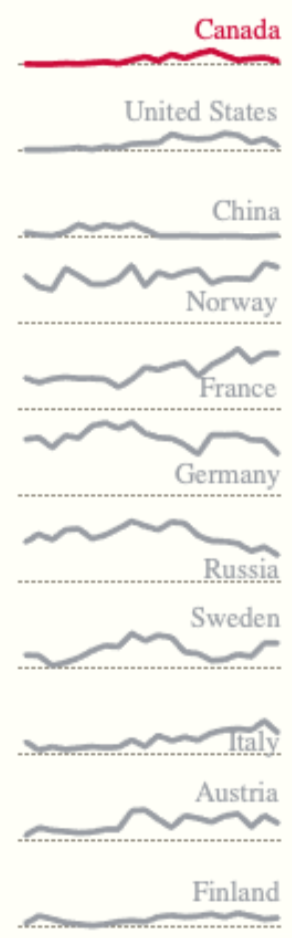
The chart on the right split some of these nations out so see individual trends and how well nations do and how they are trending. The horizontal dotted line is the base-line (0 points) so the further above the line, the more points nations have scored. It shows that Norway, France and Germany are the main high-scoring nations, Russia has lost touch with the top, and Sweden and Italy are increasing. The other shown nations, including Canada, or relatively stable at this scale.

Canada’s best
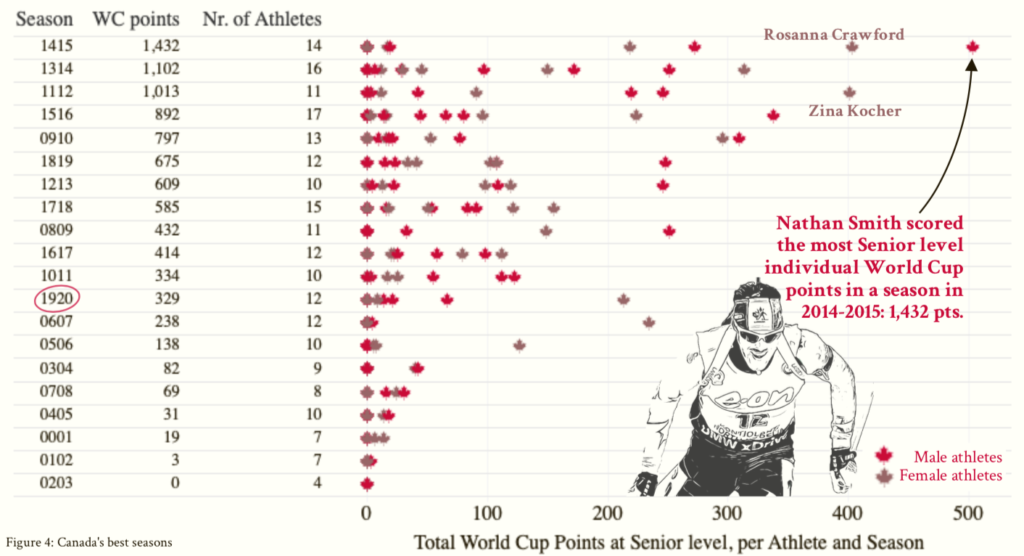
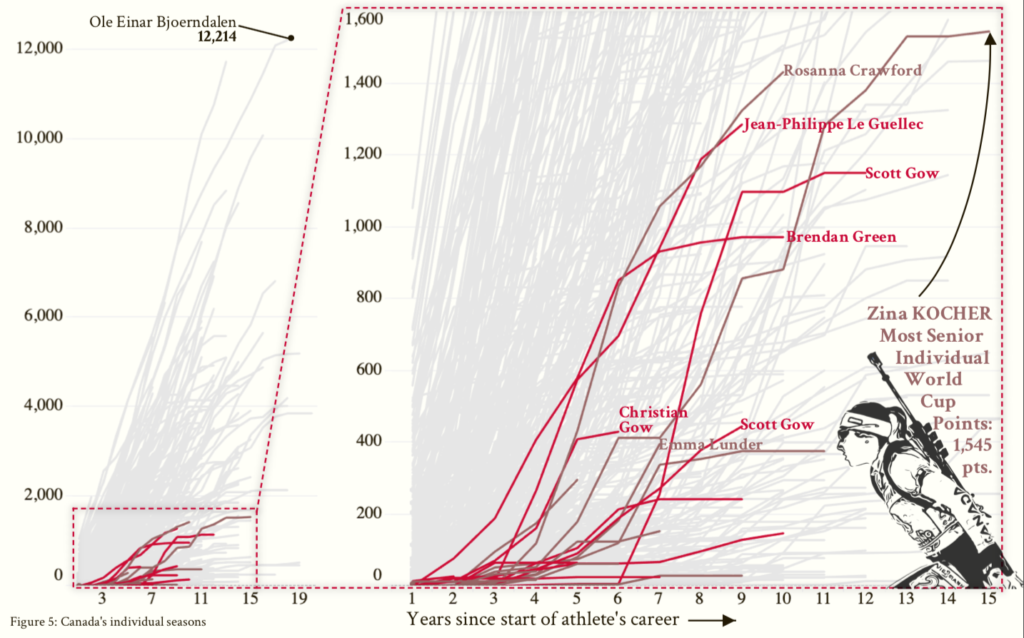
The 2019-2020 season was in the middle of the pack of all seasons since 2000, but again note that it was cut short due to COVID19. The 2014-2015 season was our best so far, looking at World Cup points, with very strong performances by Rosanna Crawford and Nathan Smith.

The charts below looks more at the development of Canadian athletes, showing total World Cup points won in individual Senior events on the vertical axis, and the n year of their career on the horizontal axis. The left side shows all athletes to highlight Canadians in the complete picture, where the right side zooms in on Canadians.
Canada’s best seasons: team events

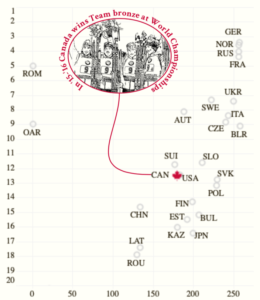
As the last couple of charts, figure 6 shows team events per nation, and how Canada performed since the 2000-2001 season by looking at the average Rank of all seasons (vertical axis) and the number of races started by a nation (horizontal axis).
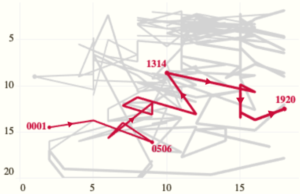
In contrast to the figure above, the figure below shows the average rank per season as a line starting in ’00-’01 and ending in ’19-’20. As Canada starts in the bottom left (labelled 0001 for season ’00-’01) it starts moving to the right (more races) and up (better average ranking). The upward progression stops after the ’13-’14 season, but the ’19-’20 season shows an improvement again. Hopefully, this can be continued in the next season!
The full pdf of the article above can be downloaded below.

PuckPossessed7_CanadiansDownload
Posted in Statistical analysis | Tagged Canada, Puck Possessed

Contribution from skiing and shooting performance to the overall sprint race performance

Posted on 2020-03-11 | by biathlonanalytics | Leave a Comment on Contribution from skiing and shooting performance to the overall sprint race performance

by Najtrebor
Puck Possessed

I got inspired by a research article by H. Luchsinger†, R.K. Talsnes†, J. Kocbach and Ø. Sandbakk from the Norwegian University of Science and Technology in Trondheim, in which they analyzed the performance of 11 elite male biathletes to “investigate the contribution from overall XC skiing performance … and shooting performance to the overall biathlon sprint race performance”, amongst other purposes. 

This issue of Puck Possessed Biathlon duplicates some of their research based on the women’s sprint races starting in the 2017-2018 season until present to see if and how it matches.

Posted in Statistical analysis | Tagged Puck Possessed, shooting, skiing

Who shoots better: Men or Women?

Posted on 2013-08-27 | by real biathlon | Leave a Comment on Who shoots better: Men or Women?

According to my blog stats the question if men or women are the better shots has always been one of the top search keywords that point people to this site. I wrote a post about that a long time ago, but since it’s of high interest apparently I took a more detailed look at the gender differences in biathlon shooting.

Note: It’s difficult to make any definitive statements about shooting trends, because it all depends on what group of athletes you look at. There isn’t one single group which represents the strength of the whole field perfectly, so it will always be slightly imprecise.

2001
–02
2002
–03
2003
–04
2004
–05
2005
–06
2006
–07
2007
–08
2008
–09
2009
–10
2010
–11
2011
–12
2012
–13
Top 10+3.0-1.4+2.9+6.6-0.3+2.8-2.2+1.7-1.6+1.6-0.8+1.6
Top 20+2.6+1.0+3.0+2.2+1.3+1.9+0.7+0.4-1.9+2.0-0.5+1.2
Top 30+1.2-0.3+2.7+4.1+1.2+1.5-1.0-0.3-1.5+1.6-0.2+0.1
Top 40-0.5+0.3+3.0+2.3+0.7+0.7-2.2+1.0-1.3+1.0+1.6-0.1
Top 60-0.2+0.8-0.2+1.6+1.6+1.2-1.3+0.9-2.0+0.3+1.0+2.3
Top 100+0.2+1.9-0.1+0.5+2.3+0.6-0.1+0.6-2.4+0.2-0.1+2.2
Shooting percentage differences  (in %)    Men / Women   per selected group, last 12 years
Positive values: men were more accurate; Negative values: women were more accurate

During the last 12 seasons, the differences in non-team shooting accuracy between men and women have been small. For two seasons (2007–08 and 2009–10) women were better, in 2004–05, 2006–07 and 2010–11 men are ahead across the board. For most of the other seasons there is no clear picture, although men’s shooting results lead more of the selected groups (and often with bigger margins).


Last year, the shooting percentages for men and women were virtually identical for the top 30 or top 40, however men were over 2 % more accurate in the broader groups (top 60 or top 100). Overall, you probably have to give men a slight edge (of maybe 1 %), even though women were clearly better from 2007–08 to 2009–10.

2001
–02
2002
–03
2003
–04
2004
–05
2005
–06
2006
–07
2007
–08
2008
–09
2009
–10
2010
–11
2011
–12
2012
–13
Top 10+4.2+1.4+3.3+2.4+3.3+1.7+2.8+3.1+4.3+4.3+3.4+5.2
Top 20+3.7+1.5+2.4+1.7+2.6+3.2+3.0+3.2+2.9+3.3+3.4+3.5
Top 30+2.3+1.6+2.3+2.0+3.5+3.7+3.2+3.3+2.5+3.5+3.8+3.7
Top 40+2.3+2.3+2.0+2.2+3.7+3.4+2.7+3.4+2.5+4.1+4.2+3.5
Top 60+2.8+2.9+2.6+2.6+2.6+3.3+3.4+3.1+2.8+3.8+4.2+3.7
Top 100 +2.8+3.1+3.0+2.3+2.6+3.4+2.7+3.2+3.4+4.1+3.9+4.2
Male Shooting Time advantage  (in sec) per selected group, last 12 years

In terms of shooting time, the gender differences are much more obvious. Men shoot considerably faster. In fact, men have increased the gap from about 3 to 4 seconds in the last 12 years. 
Physical strength plays a small part in shooting (relative to their body weight the rifle (3.5 kg) is heavier for most women), but differences of 10 % and more in average shooting time are quite a lot. The large gap might partly be down to a different mental approach (risk taking/range strategy?).

If you combine shooting accuracy and shooting pace and look at the time lost at the shooting range, the gap between men and women becomes much bigger (about 20 s last season for sprints). However, at least half of that range time is spent on skis, so this comparison is unfair: women lose almost 2 seconds approaching and exiting the range and they ski the penalty loop about 3 seconds slower than men.

What’s the bottom line? Generally, men shoot better than women: they are not necessarily more accurate, but on average much quicker (in a sprint about 4*2 = 8 seconds only in “shooting time” last year).

Posted in Statistical analysis | Tagged shooting

How to get on the podium in biathlon

Posted on 2013-07-27 | by real biathlon | Leave a Comment on How to get on the podium in biathlon

Last October, I looked at what kind of shooting and skiing results it usually takes to get on the podium in biathlon World Cup races, both overall and for each of the four disciplines (see podium ingredients for men and women). Now I was curious if those trends had changed at all during the last 12 years. Below, I split the results into four 3-season periods (2001–04. 2004–07, 2007–10, 2010–13, between 73-80 races each) to examine that a bit more closely. 

Note: The tables and charts show percentages for World Cup podium finishers for the respective time periods, i.e. how often first, second and third place had a certain number of shooting penalties or a specific course time rank.

The first thing you notice is how stable the charts are, unsurprisingly I suppose (the rules haven’t changed, the World Cup programme is almost the same). For the men, the skiing numbers hardly changed at all, 54.3 % of all podium finishers set a top 5 course time during 2010–13, a decade earlier it was 54.8 %;  the top 10 course time rate is virtually identical as well (76.5 % vs. 76.7 %). 


What has changed however are the shooting results. For 2001–04, 58.9 % of all podium athletes had 0 or 1 shooting errors. That percentage increased considerably until 2010–13: 65.8 % → 65.8 % → 71.8 %. It seems good shooting is more important than ever in men’s biathlon.

Shooting penaltiesSki rank
Men01234> 4123Top3 Top5 Top10 > 10
2001–04    29.729.2 21.5 10.04.1 5.5 14.6 10.0 11.9 36.554.876.723.3
2004–0733.332.520.8102.90.413.115.611.440.157.479.720.3
2007–1031.634.218.212.62.21.311.712.69.533.850.671.428.6
2010–1332.539.319.76.81.30.417.510.712.440.654.376.523
Shooting penalties / Ski ranks for all Podium finishers (non-team races) in % | Men

In general, the percentages for the women are quite similar, maybe more similar than you would expect (considering men and women compete on different courses). Unlike for the men, the percentage of great shooting for female podium finishers did not increase: during 2001–04 we had 61.2 % with 0 or 1 penalties, 60.3 % for 2010–13.

However, fast skiing is getting more important for the women. The percentage of female athletes with top 5 (50.2 % → 52.9 % → 53.2 % → 62.4 %) or top 10 course times (76.7 % → 78.3 % → 81.8 % → 88.0 %) among all podium athletes increased a lot in the last 12 years.

ShootingpenaltiesSkirank
Men01234> 4123   Top3     Top5   Top10   > 10
2001–04    29.729.2  21.5  10.0 4.1 5.5 14.6  10.0 11.9 36.554.876.723.3
2004–0733.332.520.8102.90.413.115.611.440.157.479.720.3
2007–1031.634.218.212.62.21.311.712.69.533.850.671.428.6
2010–1332.539.319.76.81.30.417.510.712.440.654.376.523.5
Shooting penalties / Ski ranks for all Podium finishers (non-team races) in % | Women

It seems as if the men’s and women’s competition has developed in slightly different directions. For the men, the importance of good shooting is more significant today than it was 10-12 years ago, while top ski speed has become even more important today on the women’s side.

Posted in Statistical analysis | Tagged results

Posts navigation

Newer posts

Recent Articles

  • Biathlon World Cup podiums (1958 – 2025)
  • Junior + U23 Development Index – Men
  • Junior + U23 Development Index – Women
  • The Path to GOAT Status
  • Most improved athletes this winter

Categories

  • Biathlon Media
  • Biathlon News
  • Long-term trends
  • Statistical analysis
  • Website updates

Archives by Month

  • 2025: J F M A M J J A S O N D
  • 2024: J F M A M J J A S O N D
  • 2023: J F M A M J J A S O N D
  • 2022: J F M A M J J A S O N D
  • 2021: J F M A M J J A S O N D
  • 2020: J F M A M J J A S O N D
  • 2015: J F M A M J J A S O N D
  • 2013: J F M A M J J A S O N D
  • 2012: J F M A M J J A S O N D

Search Articles