real biathlon
    • Athletes
    • Teams
    • Races
    • Seasons
    • Scores
    • Records
    • Blog(current)
    • More
      Patreon Content Videos Explanations Shortcuts
      Error Report
      Privacy Policy About
    •     
  • Forum
  • Patreon
  • X
  • YouTube
    Instagram
    Facebook

Recent Articles

  • Biathlon World Cup podiums (1958 – 2025)
  • Junior + U23 Development Index – Men
  • Junior + U23 Development Index – Women
  • The Path to GOAT Status
  • Most improved athletes this winter

Categories

  • Biathlon Media
  • Biathlon News
  • Long-term trends
  • Statistical analysis
  • Website updates

Archives

  • 2025
    • November
  • 2024
    • March
  • 2023
    • March
  • 2022
    • December
    • June
    • May
    • March
    • February
    • January
  • 2021
    • December
    • November
    • September
    • July
    • June
    • May
    • April
    • March
    • February
    • January
  • 2020
    • December
    • November
    • August
    • June
    • March
  • 2015
    • December
  • 2013
    • August
    • July
  • 2012
    • July

Search Articles

Recent Tweets

Tweets by realbiathlon

Category: Biathlon Media

Arnd Peiffer: Biathlon Legend?

Posted on 2021-07-16 | by Brian Halligan | Leave a Comment on Arnd Peiffer: Biathlon Legend?

In this video I contemplate the idea that Arnd Peiffer might be a biathlon legend. By comparing his results to German biathlon legends from the past, it’s easy to see that Arnd had been earning impressive results through out his 13 year biathlon career. The Olympic Gold medalist from PyeongChang 2018 should be considered one of the biathlon greats.

Posted in Biathlon Media, Statistical analysis

The Story Of Tiril Eckhoff

Posted on 2021-06-18 | by Brian Halligan | Leave a Comment on The Story Of Tiril Eckhoff

This victory in Oestersund marked Tiril Eckhoffs record breaking 13th victory in a single season. Breaking Magdelena Forsberg’s record of 12 victories in the 2000-2001 season. While biathlon fans today are familiar with the bubbly and exciting personality that Tiril is known for, this impressive accomplishment didn’t come easy. In today’s video, we will dive deep into the career of Tiril Eckhoff and see how the record that captivated fans during the 2021 season was an accomplishment of hard work and breaking through personal barriers.

Hopes were high for the young Norwegian athlete. At only 21 years old, Eckhoff had earned some impressive results at the IBU Junior World Championships only weeks prior to her W.C. debut: All of Norway could see the young athlete had a lot of promise and hopes for the future were high. Eckhoff continued to improve on the skis and established herself as one of the fastest skiers on the circuit by the 2013-2014 season and consistently earned in the top 20 results. Eckhoff earned a place on the Norwegian Olympic team and helped the women’s team capture a gold medal in the Sochi relay.

Tiril started off the 2014/15 season with a bang: earning her first world cup win by shooting 90% in the Oestersund Sprint. Despite Eckhoff consistently placing in the top 10 in ski speed and skiing 4.2% faster than the average biathlete, Tiril had a hole in her performance that would hold her back and actually make her finish lower in the standings than the previous season: a 79.4% shooting percentage. And specifically, a 74.1% standing percentage. Six times Tiril would clean her prone stage only to spoil the race with standing misses. In fact, Tiril only cleaned her standing twice during this season, and both times she did that she earned podium finishes. So what was Tirils plan to combat this weakness in her game: Ski faster! This plateau continued for several seasons: It was the same old story of fast skiing, good prone shooting and meltdowns in the standing stages.

Despite her plateau Eckhoff would occasionally excite the norwegian fan base with stellar performances. Most notably, her performance at the 2016 IBU World Championships at her home stadium of Oslo Holmenkollen. In front of the King of Norway, Eckhoff performed at her best winning the Sprint competition with clean shooting and helping the Norwegian Women’s relay team claim victory by bringing the team from 9th to 1st without missing a shot on the third leg.

In 2017 rumors began circulating that Tiril was having some issues with her vision and was focusing on rehabilitating her eyes. She told IBU TV she had “double vision” and spent a lot of time in the summer focusing on what she sees when she looks through the sights.

The results of her hard work began paying off in the 2019/2020 season where she bumped her shooting percentage up to 83% and skied 5.3% faster than the average athlete. This jump in the shooting percentages helped Tiril break through the ceiling and get back into the top 10 overall. Winning 7 races during the season and battled Italy’s Dorothea Wierer for the overall globe through the entire season which was cut due to the Covid-19 pandemic.

As mentioned in the beginning of the video, Tiril would go on to win 13 races this season and set a Women’s World Cup record. But the interesting thing about this accomplishment is when you look at her stats on the season, she actually under performed in the key areas that propped her up in previous seasons.

The area that gave Tiril her edge was the one piece that plagued her in the past: her standing shooting. Up a full 10% from the season before, Tiril had honed in the standing targets and was able to close the door on great victories. We see this all too often in biathlon where an athlete ruins a good race with poor standing shooting. And we also see examples of athletes coming back from poor starts to finish strong with good shooting in the later stages.

When you look at the numbers, this concept makes sense. In a typical 12.5k Women’s mass start each lap it takes the fastest skiers approximately 6:20 to ski the 2.5k course, this means at the completion of the last shooting an athlete only has 17.5% of the race remaining to make a comeback if needed. Whereas after the prone shooting 60% of the race remains.

Tiril Eckhoff’s dedication to focusing on her performance weaknesses and ability to break through her results plateau is a lesson for athletes around the world. Sticking with the training, and continuing to work hard can help you achieve new heights. It will be interesting to see if Tiril can continue her success this upcoming season. And it would be exciting to see what she could do if she could combine her new found standing ability with her highest prone percentages of years past.

Posted in Biathlon Media, Statistical analysis

It’s all for the money. Or is it?

Posted on 2021-04-19 | by biathlonanalytics | 1 Comment on It’s all for the money. Or is it?

Introduction

Recently Real Biathlon posted data about World Cup Prize Money in biathlon on his website for Patreon members. Combined with all the other data sources he provides, if you like working with data and biathlon why not look into becoming a member as well and support him in keeping the site running? For the Prize Money data, you can easily find the major all-time earners, sort by gender and year, and use the data combined with other data sources he provides.
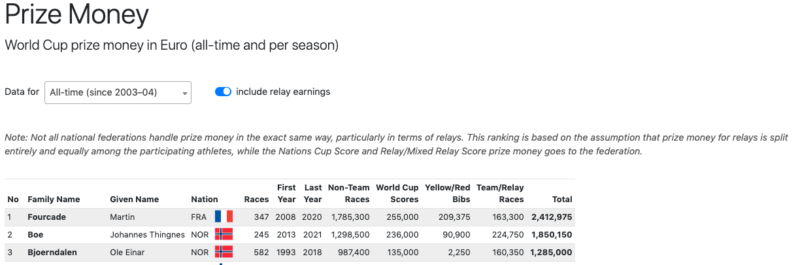
In the post below I have tried to look at the data from the less obvious perspectives, and see if we can get some interesting stories out of it.

Data source

The data contains all income from the IBU at the World Cup level, and excludes any income made from external sources like sponsorships, bonuses from national federations, etc. the data range starts with the 2003-2004 season and it should be kept in mind that some athletes were already active before this season so that data is not included. For team races, the data is based on the assumption that prize money is split entirely and equally among the participating athletes.

The Prize Money data source is in Euros as that’s the currency used in the IBU season guides, the source of this data for most (or all) seasons.

Equality

The first thing I wanted to explore is how the IBU deals with equality. And it’s fairly simple: prize money is based on race results, world cup scores, and bibs. And it is unrelated to the gender of the athlete; in other words, the prize money is equally handed out between man and women.
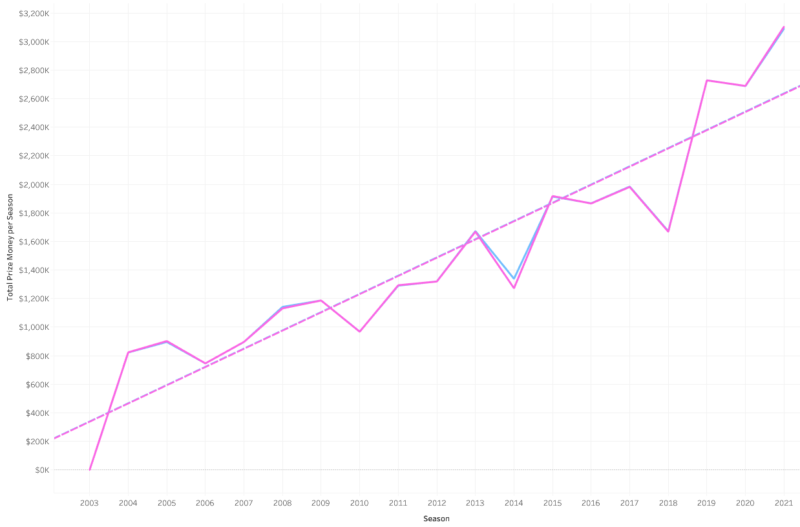
The small changes are likely happening as in some races more athletes get prize money, which then adds up for the season (say three athletes don’t finish a mass-start, the prize money is not handed out). The 2014 season seems to be the only year with a bigger difference, and quite frankly I don’t know why that is. But generally, we can see the pink line for the women pretty much overlaps the men’s blue line.

How is the money divided?

If we look at how the prize money is divided, we see that the majority of athletes do not make a lot from their sport (strictly looking at prize money). Of the 561 athletes in this dataset, only 27 (4.8%) have made over a million where 241 made €10,000 or less. And 428 athletes (76%) have made €100K or less since 2003-2004. It also appears the men are a bit more top-heavy with 26% making €100,000 or more, which is only 22% for the women.

Earning pace

I was curious to see how athletes compared when looking at how much they earned in their first, second, etc. year in the World Cup. I should remind you that if athletes were already active before the 2003-2004 season, their total earnings do not include the seasons before that.
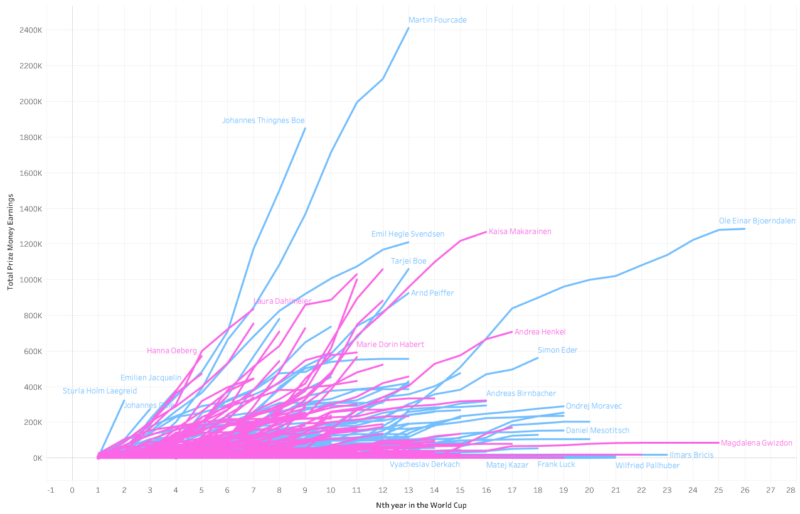
We can see a number of interesting things here, for example that Bjoerndalen didn’t make money until his 12th season (due to the above-mentioned limit in available data), Martin Fourcade made the most in total but could be caught up with by JT Boe, and Jacquelin, Dale and Laegreid are also on pace to get to Fourcades total faster or go above it. Hanna Oeberg and Denise Herrmann are on track for the women to become the biggest prize money earners, although Herrmann started later in her career with biathlon.

Another way to look at this data is average money made per race. I filtered the chart to only show those athletes that have between 30 and 150 races (to highlight the “new kids on the block”) and have a average of at least €1,500 per race:
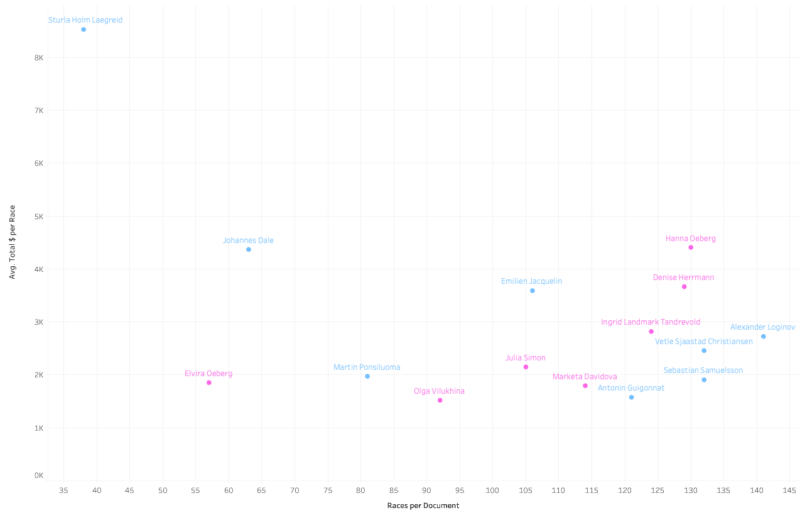
After Laegreid’s amazing first full season, it is no surprise to see him high up in the top-left corner. Dale, Jacquelin and Ponsiluoma are also in a strong position to make good money in the upcoming years if they can keep their rates going. For the women, Hanna and Elvira Oeberg, Herrmann, Tandrevold, Simon, Vilukhina and Davidova also have great ratios up to this point in their careers.

Riding the good team train

The last thing I wanted to look at are athletes that have made good money in Team races, but not so much in individual races. In other words, who has been riding the good-team train?

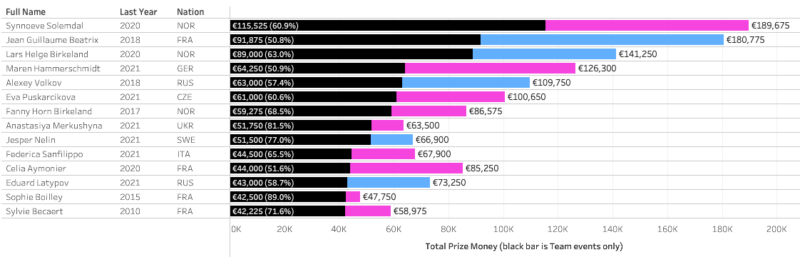
The chart below shows all athletes and their total prize money for team/relay races, and the percentage of earnings for team/relay races compared to their total earnings. To highlight the “train riders” (filled in circles) I selected those athletes who made more money with team/relay events than other ways (team/relay earnings > 50%) and who made more than €40,000 on team races:
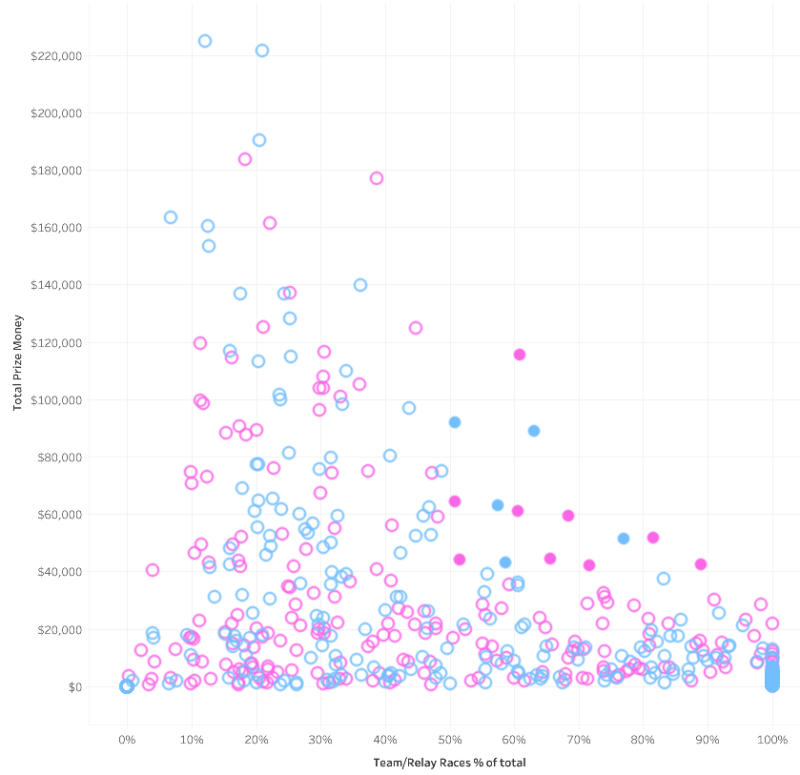
Below are the highlighted athletes with more details. We can see that an athlete like Merkushyna made 81.5% of her earnings through team/relay events for a total of €51,750. Given that she has not made much money in individual races, I think she is one of the athletes who most benefitted from being on a good team. Sophie Bailley is another great example.
This Prize Money dataset is a great addition to the site, with plenty of interesting stories to tell!

Posted in Biathlon Media, Statistical analysis | Tagged Prize Money

Canadian biathletes finding balance

Posted on 2021-04-06 | by biathlonanalytics | Leave a Comment on Canadian biathletes finding balance

With three top 10s, sixteen top 20s and twenty-five top 30s in individual events, the 2020-2021 season was the best Canadian season in the last five years. After a dip in total World cup points in the 2019-2020 season, last season continued on the five-year trend of continuous increase in total world cup points:

So what did Canada do well to get here, and where is there still room for improvement? That is what the following review of the Canadian individual performances in the 2020-2021 season will analyse! In this analysis, I will only show some examples of Canadian performances, but a supportive dashboard with all used data for this analysis can be found on my Tableau Public page. It shows all stats for the Canadian team, both men and women, and has a second tab where a Canadian athlete can be selected to show his or her specific stats.

Skiing time

The skiing is still the area where the Canadian team overall can gain the most time. In the specific example below I compare the average ski times of the Canadian athletes to the field average, the average of the top 30 athletes, and the average of the top 10 athletes:

Although we can see Canada is closing up the gap a little compared to last season, we are still behind the overall average, and far behind the top 10 athletes. But the positive news is that we made great progress in the 2020-2021 season, indicated by the steep drop towards the averages.

Shooting time

This is where Canada has the least to gain (and the most to loose) as we continue to be very strong in fast shooting, leading many of the true biathlon nations:

Shooting accuracy

In previous seasons the fast shooting times by the Canadians often lead to less desired shooting percentages, but it appears the team and coaches are starting to find a balance between shooting fast and shooting accurate, demonstrated by both increased accuracy in Prone and Standing:

Shooting speed -vs- Accuracy

This balance between shooting fast and clean is of course the golden grail of shooting in biathlon (I wrote about this in more depth on this website in December last year). The chart below shows how this balance has changed for the different team, starting in 2016-2017 (thin line) and how teams have moved from shooting more or less accurate, and faster or slower. We see that in 2018-2019 team Canada put a lot of focus on shooting faster, which worked, but at the expense of less accuracy. Now we see that we have lost some speed (but are still very fast) but have gained accuracy. Hopefully, this trend can continue upwards towards more accuracy while remaining fast.

Individuals

The second part of the evaluation is looking at the individual athletes. All Canadian athletes can be viewed on the interactive dashboard, but here I’m letting Emma Lunder be the example here. We can see that here Accuracy -vs- Speed trend is similar to the Team’s and that she is gaining accuracy while giving up a little speed. But we can also see that here range, shooting and prep time (prep = range – shooting) is still very good and well below the field’s average:

Her total percentage of shooting accuracy (T) has increased mostly based on a strong increase in her prone shooting (P) and she well above the field’s average Total shooting percentage (T avg.). Lastly her skiing speed seems to have stabilized and is on par with the field’s average. But she is also closing the gap with the Top 30 and Top 10 averages.

Conclusion

As mentioned team Canada had a great season, as did Emma Lunder. The above will hopefully give a good explanation of how to read the interactive dashboard to see both men’s and women’s team performances for individual races, and the individual dashboards for any of the Canadian athletes. If the current trends continue and with some of the younger athletes coming through the pipeline, hopefully, we can some Canadian podiums in the next season! Go Canada!

Posted in Biathlon Media, Long-term trends, Statistical analysis
SkootBiathlonBoardgameLogo

SKOOT – a D.I.Y. Biathlon board game

Posted on 2021-03-05 | by biathlonanalytics | Leave a Comment on SKOOT – a D.I.Y. Biathlon board game
SKOOT logo

SKOOT is a Biathlon board game that you make yourself with a printer and some glue or tape, a few dice and some playing tokens (lego works great). It is based on rolling dice and making strategic decisions, in which competitors ski three loops and shoot twice. For the skiing part, the effort is based on tactics and players use dice to determine the number of tiles they go along the course. The shooting success is determined by a tactical decision and rolling a die for each of the five targets. The game is easy to learn and can be played by young and old, and anywhere in between. It comes in a basic version suitable for younger kids (eight and younger) or you can use an add-on to make the tactics more involved.

Required to play the game

  • The board with the ski track, a recovery area, a shooting area, a penalty loop and a finish section – to be printed
  • At minimum five dice, but ideally eight dice (two for skiing, one for recovery and five for shooting)
  • A token for every racer (Lego one-size blocks work quite well)
  • A token of the same colour for the Heart Rate Meter when playing the Heart Rate Meter Add-on
  • A piece of paper to write down the tactics per player per lap (lap one and two only), recovery, missed shots; see example below. Only for the game played without the Heart Rate Meter Add-on

Files to be printed

For any of the files, please go to https://biathlonanalytics.com/skootbiathlonboardgame/ where everything is available for free.

Posted in Biathlon Media | Tagged boardgame, DIY

Posts navigation

Older posts
Newer posts

Recent Articles

  • Biathlon World Cup podiums (1958 – 2025)
  • Junior + U23 Development Index – Men
  • Junior + U23 Development Index – Women
  • The Path to GOAT Status
  • Most improved athletes this winter

Categories

  • Biathlon Media
  • Biathlon News
  • Long-term trends
  • Statistical analysis
  • Website updates

Archives by Month

  • 2025: J F M A M J J A S O N D
  • 2024: J F M A M J J A S O N D
  • 2023: J F M A M J J A S O N D
  • 2022: J F M A M J J A S O N D
  • 2021: J F M A M J J A S O N D
  • 2020: J F M A M J J A S O N D
  • 2015: J F M A M J J A S O N D
  • 2013: J F M A M J J A S O N D
  • 2012: J F M A M J J A S O N D

Search Articles