real biathlon
    • Athletes
    • Teams
    • Races
    • Seasons
    • Scores
    • Records
    • Blog(current)
    • More
      Patreon Content Videos Explanations Shortcuts
      Error Report
      Privacy Policy About
    •     
  • Forum
  • Patreon
  • X
  • YouTube
    Instagram
    Facebook

Recent Articles

  • Biathlon World Cup podiums (1958 – 2025)
  • Junior + U23 Development Index – Men
  • Junior + U23 Development Index – Women
  • The Path to GOAT Status
  • Most improved athletes this winter

Categories

  • Biathlon Media
  • Biathlon News
  • Long-term trends
  • Statistical analysis
  • Website updates

Archives

  • 2025
    • November
  • 2024
    • March
  • 2023
    • March
  • 2022
    • December
    • June
    • May
    • March
    • February
    • January
  • 2021
    • December
    • November
    • September
    • July
    • June
    • May
    • April
    • March
    • February
    • January
  • 2020
    • December
    • November
    • August
    • June
    • March
  • 2015
    • December
  • 2013
    • August
    • July
  • 2012
    • July

Search Articles

Recent Tweets

Tweets by realbiathlon

Author: biathlonanalytics

Proud dad&husband; analyst & visualization specialist (Tableau, SQL & R); creator of Biathlon Analytics; blog poster on realbiathlon.com; passionate about biathlon, cross country skiing and canoeing
An exploration of Biathlon Relay Race data

Exploring Biathlon Relay race data

Posted on 2021-03-05 | by biathlonanalytics | Leave a Comment on Exploring Biathlon Relay race data

So far I have only worked with data from the individual races, but I wanted to familiarize myself more with the relay data. So I took yesterday’s crazy women’s race and did some research on their relay.

Progression of the race by rank

Team average skiing and shooting times

Note: the axis are reversed, so top right is good, bottom left not so good

Noticeable is Kazakhstan, not one of the most prominent countries in biathlon at this point, who ranked second in fastest Average Range Time. Not let’s see how their (and other countries’) shooting went:

Shooting

With only two reloads, it is no wonder Kazakhstan had a very good Range Time. Czech Republic had a horrible day at the range with 5 penalty loops and 16 reloads. Sweden, the eventual winner, had 6 reloads.

When we look at the combined efforts of all team members per team, we can see what the spread was within the teams. The closer they were, the more consistent they raced as a team. The following chart has four columns per team: the total leg time per athlete per team, also showing the team’s spread; the average leg time for the team; the spread expressed in Standard Deviation; and the average range time per team:

Spread within team

This shows that Sweden and Belarus were very consistent as a team, as were Germany, Poland and Japan for example. On the other hand Norway had some great performances, but also some weak ones, not very consistent. Finland had the biggest spread.

If we start digging one layer deeper, let’s look at the Top 5, Canada and USA and who their best performers were, based on total course time per leg (coloured bars) and their three course-laps course times (dots: light blue is course 1, dark blue is course 3). The athletes are sorted within their teams based on the best total course times:

Teams’ best performers

The chart above also shows how consistent their three-course times were; the closer together, the more consistent. I all cases the third course was the fastest, which makes sense as they have done their shooting by then and can go all-out. The following shows, again for only the Top 5, Canada and USA, the right column from above in more detail and has ordered by athletes with the fastest course time (in every case their third):

Fastest course times

Not shockingly, Tiril Eckhoff had the fastest course time in her third course. Tandrevold was third, but Roeiseland and Lien were 12th and 15th.

Lastly, we can look at individual performances. I recommend going to the interactive version of the report, and when hovering your mouse over the name of a column, you can click the sort ascending or descending button to see who’s best, and who is not. Below I show the Top 15 athletes per measurement:

Individual performances

Best total time per leg (three loops, skiing and shooting)
Best total skiing time per leg (three loops, skiing only)
Best time of fastest course time (one course, skiing only)
Best time for total shooting time per leg (two shootings)
Best time for total range time per leg (two shootings)

This concludes my examination for now, but now that I am more familiar with the relay data, I’m sure you’ll find more research and postings about relays in the future. Cheers!

Posted in Statistical analysis | Tagged Data, Relay

Pokljuka Mass Start Men in Comic form

Posted on 2021-02-24 | by biathlonanalytics | Leave a Comment on Pokljuka Mass Start Men in Comic form
Pokljuka2021MassStartMenComicDownload
Posted in Biathlon Media | Tagged comic

When to start (in an interval start race)?

Posted on 2021-02-17 | by biathlonanalytics | Leave a Comment on When to start (in an interval start race)?

This is a research project about when to start in individual and sprint races based on impact of conditions. I wanted to see in the data if starting early or late in the race had a positive or negative impact on the skiing and shooting of competitors.

For skiing I will use the Z score, and compare the athletes’ season average score to their actual race score, per athlete bib. This gives a much fairer number as strictly looking at the Z score per athlete, the skiing ability comes into play. When comparing to the season average of the athlete, you can say, regardless of skiing ability, if an athlete was faster (neg. or slower (+) than his or her average.

I also added the three weather data points at the start, after the start (+30 min.) and at the end of the race, around +80 minutes. like so:

The logic of the weather timing is a follows: “at the start” is time 0, or when the first athlete leaves. “After the start” is 30 minutes after the start of the race. In 30 minutes 60 athletes will start (half-minute intervals), and about 30 of them will spend most of their time in “at the start” weather. The the “at the start” group is bibs 1-30. Then the last measure point is when the last athlete finishes, so quite a bit later, depending on the type of race. On average I’d say bibs 31-80 spend most of their time in the “after the start” weather, and after that, they spend the most time on the “finish” weather.

So to see how every athlete performed compared to their season average, I subtracted the season value from the actual race value; any score above zero means slower than season average, and anything below would be faster than season average:

But this is still not giving much information, just lots of data. So to simplify and aggregate some data I looked at the bib numbers of athletes that fall into the different weather groups:

Well, it’s telling us more but perhaps a little to aggregated? Also we should have a look at the axis, as this image suggests large differences, the at the start group is only 0.0859 faster than season average, so the actual impact in this race example is actually very small.

To get to a detail level somewhere in between, I grouped the athletes by 10s of bib numbers, 1-10, 11-20, 21-30, etc., both for the Actual vs season average and the delta where I average the 10 athletes within each group:

This level of detail looks about right, here we can generally see the “weather groups” but still have a bit more details. The average lines also provide useful information when comparing the three weather groups, or the bib groups within a weather group.

Now we can do the same for Shooting Z Scores:

Now that you have read this please play with the dashboard located on Tableau Public and see where the starting bib combined with conditions had a positive or negative impact on the athletes.

Posted in Long-term trends, Statistical analysis

Predicting the World Championships in Pokljuka

Posted on 2021-02-06 | by biathlonanalytics | Leave a Comment on Predicting the World Championships in Pokljuka

One of the reasons I really love biathlon is that it is unpredictable. Yes, there are favourites who win more regularly than others, but there are always a large number of athletes who can take the win. Yet my next Tableau Dashboard is called Pokljuka Predictions. Well, I ran out of space to add “well, not really”. But to make predictions to the best of one’s ability, having all the right information in front of you is the best option you have. And that is what this dashboard is supposed to do: provide useful information that allows making the best possible prediction.

The dashboard works per Race Category (gender) and Race Discpline. After selecting these two parameters we can have a look at the charts but first, let’s look at some info on the events.

They are held in Slovenia, at the Pokljuka Biathlon Stadium

The program is a busy one for the athletes, but this report excludes the relays.

After setting the filters, three of the four “columns” show data, where the central column at the bottom shows data when an athlete is selected.

The scatterplot shows the athletes related to their last race in Pokljuka in this Discipline and their current standing in the World Cup for this discipline. X’s mean that the athlete either did not participate in the most recent Pokljuka event, or is not in the current season Discipline Standings. It gives an idea of what athletes are good this season and did well in the last race in Pokljuka for this discipline. They will show up in the top right.

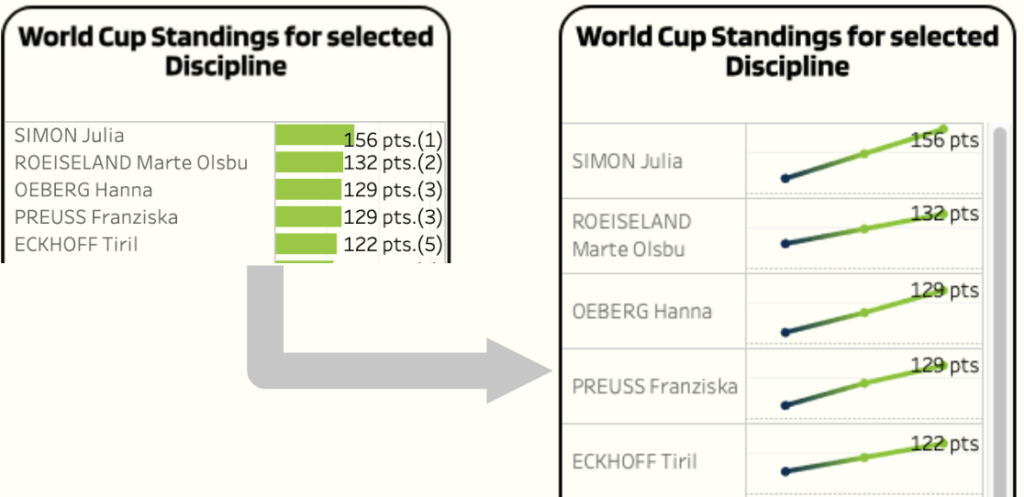
The following two charts show similar data from above but individually: the race results for this discipline in previous seasons (when available), and the current World Cup standings for this discipline with points and ranking in brackets.

When selecting an athlete in any of these charts, we can see the current season results in the selected discipline for the selected athlete, compared to their career (since the 16-17 season) average (dark blue dashed line) and the current season’s average (light blue dotted line).

This is followed by the athlete’s current form based on consistency;it shows the absolute change in rankings per season, so the higher the value (lower on the chart), the larger the inconsistency. And the steepness of the decline shows the athlete’s form. Steep points to a big change in results, where a almost flat decline indicates that recent results were similar. It does not indicate however if these results were high or low in the ranking. If an athletes was 45th, 43rd and 44th the line will be almost flat indicating strong consistency. this will gie you an idea of likelyhood that it will change soon, or if this athlete’s performance is pretty reliable.

Last thing to mention is that when you hover your mouse over a name of an athlete, it highlights that athlete in other charts.

So all in all not a true predictor, but a tool providing information to make a better-informed prediction quicker.

UPDATE – Predictions after all, and some updates to the dashboard

So, based on the information on the dashboard I really felt I should make some predictions after all. Although I will not commit to pointing who will get what place, I will highlight the top favourites for every race, based on the dashboard.

I also changed one chart on the dashboard replacing the one that showed the current standing to the cumulative points this season to give a better idea of when the points were scored; recently or early in the season:
Men’s Sprint – It’s hard not to bet on JTB here; He won in Pokljuka in the 18-19 season, he won the last two sprints, has a lowest ranking of 4th this season and leads the Spring Standings. His brother Tarjei, was 4th two seasons ago, had a win and second place this season but a lowest ranking of 15th, so definitely more inconsistent. He’s 4th in the current standings. Outside favourites are Lukas Hofer, recently in good shape and improving, and despite his miserable rankings this season so far I would not write off Loginov: he was 3rd in 18-19 at this venue, and won last year’s World Championships in Antholz, showing he knows how to peak for a major championship. Dale and Laegreid are 2nd and 3rd in the current season standings but with only one and zero respectively World Championships and Pokljuka races under their belt (with a 23rd place for Dale in Antholz) I can’t see them ending up with a gold medal.

Women’s Sprint – Eckhoff won the last three Sprints of this season, but did not participate in the most recent Sprint in Pokljuka. She also leads the standings this season. Wierer was 2nd in 18-19 in Pokljuka, and is 10th in the current standings. She has been inconsistent this season but her last race was a 2nd place. I would consider Preuss an outsider, being 9th in Pokljuka in 18-19 and a current 4th spot in the standings. Braisaz-Bouchet is another outsider to keep an eye on, being 3rd in 18-19 and scoring a 14th, 9th and 4th position in the last three races. Hauser was 50th in 18-19, but was 3rd in the last two races this season, and has since won a 1st place so she is in very good shape.

The Men’s Pursuit is harder to predict with the obvious dependency on the Sprint results. Laegreid, JTB, and Dale lead the standings, and JTB also won in 18-19 in Pokljuka. Tarjei Boe has been improving since the start of this season (12-7-7-3) and was 6th in 18-19. QFM was 2nd in 18-19, has won a race this season, but has been very inconsistent. Loginov is an outsider again, 3rd in 18-19 but the highest position of 17th this season, as is Hofer with an 8th position in 18-19 and a 5th spot in the last race.

Women’s Pursuit – Wierer and Roeiseland, 6th and 2nd in the current standings and 2nd and 5th in 18-19 have a good chance for a top 5, but based on the current season results Eckhoff again has the best cards, especially if she does well in the Sprint. Hauser and Preuss are strong outsiders again with solid scores in 18-19 and decent results this season.

Women’s Individual – Dzhima, 2nd in the standings and winning in Pokljuka in 18-19 and a 14th in 19-20 and a 2nd spot in the last race this season has the best cards for this race. Hanna Oeberg has a strong history in Pokljuka (8th in 18-19, 2nd in 19-20) but this season has not been great for her. Hauser was 9th and 7th in Pokljuka and won the most recent race this season for her first World Cup win. Herrmann and Vitozzi are strong outsiders with solid results in 19-20 (1st and 4th) and Vitozzi in 18-19 as well (6th). Vitozzi’s season has had a tough current season with a highest position of 13th, and Herrmand aslo had a rough season so far.

Men’s Individual – Since JTB won last year in Pokljuka and a 7th spot in the year prior and 4th spot on the standings, it’s hard not see him as a favourite again. Fillon Maillet was 7th last year and has a 4th and 3rd this season so he’s a contender for sure. Loginov won the most recent race but with a 16th and 29th rank in the last two races in Pokljuka, he’s an outsider. Hofer and Laegreid are outsiders as well with a 1st and 2nd for Laegreid this season, and a 4th in the most recent race for Hofer, plus a 13th position last year.

Women’s Mass Start – Simon is hard to ignore for a favourite, winning the last two races this season and being 11th in last year’s race in Pokljuka. However, Hanna Oeberg won there last year and was 3rd and 2nd this season, so I would consider her to be the favorite, even over Simon. Outsider Roeiseland won the other Mass Start this season, and had two 7th places, as well as a 6th last year. Hauser was 3rd in the last race this season and 7th last year in Pokljuka so she is a strong outsider too.

Men’s Mass Start – This will be a tight one, and both Boe brothers and Fillon Maillet all being strong contenders, with Tarjei leading the standings and being 9th last year, JT winning the most recent race, being 2nd in the standings as well as last year, and QFM winning last year, 2nd in the most recent race and 4th in the standings. Eder is a strong outsider (8th last year and most recently, and 5th in the standings), as are Doll (2nd last year, a 4th and 7th this year), Peiffer (13th last year, a 1st, 11th and 5th this season) and Hofer (10th last year, and a 4th this season).

That’s it, those are the big players in these championships, but since we’re talking biatlon here, the chances of being wrong with predictions are pretty high.

Posted in Long-term trends, Statistical analysis | Tagged Pokljuka, World Championships

A Sturla Holm Lægreid special

Posted on 2021-02-04 | by biathlonanalytics | Leave a Comment on A Sturla Holm Lægreid special

Sturla Holm Lægreid has had an amazing season so far. This visual shows all his results in IBU Cup and World Cup races, tracked by the IBU.

First, we look at the ranks and bibs he has achieved, followed by Z-Scores for Skiing, Shooting and Range Time. Then we dial in on the shooting, looking at every shot he fired, and lastly at the moving averages of his Prone, Standing and Total Shooting Percentages.

SHLspecial (PDF) Download
SHLspecial (JPG)Download
Posted in Statistical analysis | Tagged Athlete special, Sturla Holm Lægreid

Posts navigation

Older posts
Newer posts

Recent Articles

  • Biathlon World Cup podiums (1958 – 2025)
  • Junior + U23 Development Index – Men
  • Junior + U23 Development Index – Women
  • The Path to GOAT Status
  • Most improved athletes this winter

Categories

  • Biathlon Media
  • Biathlon News
  • Long-term trends
  • Statistical analysis
  • Website updates

Archives by Month

  • 2025: J F M A M J J A S O N D
  • 2024: J F M A M J J A S O N D
  • 2023: J F M A M J J A S O N D
  • 2022: J F M A M J J A S O N D
  • 2021: J F M A M J J A S O N D
  • 2020: J F M A M J J A S O N D
  • 2015: J F M A M J J A S O N D
  • 2013: J F M A M J J A S O N D
  • 2012: J F M A M J J A S O N D

Search Articles